Liver fluke risk is not necessarily uniform across a single field, according to three studies from Aberystwyth University examining the parasite’s host snail, its attachment to pasture plants and the grazing choices of individual lambs.
The findings indicate that lambs sharing the same grazing area may encounter different levels of risk, depending on the vegetation they select and the parts of the field they use. Soil characteristics and the distribution of suitable habitat for the snail Galba truncatula were also identified as important factors.
Wet ground was not always suitable snail habitat
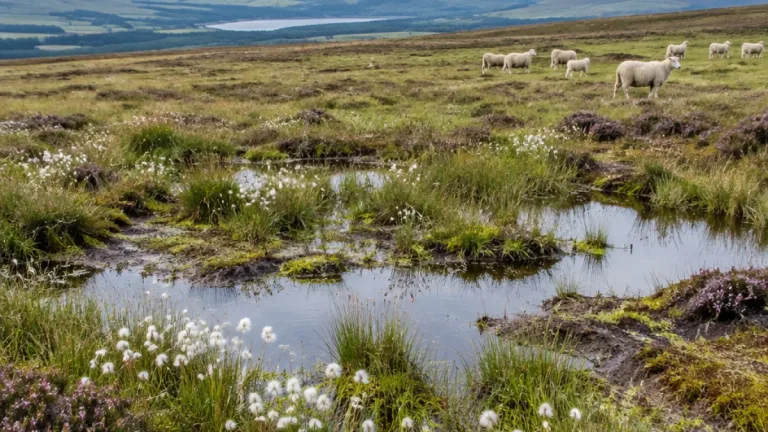
The first study surveyed 146 wet areas across 16 Welsh farms. Although liver fluke is commonly associated with wet and muddy ground, the snail required to complete part of the parasite’s life cycle was found in fewer than half of the areas examined.
Snails were less likely to occur where soils were more acidic, particularly at a pH below about 5.5. Lower numbers were also recorded in soils containing more organic matter and less clay. The results suggest that the presence of wet ground alone does not provide a complete picture of where exposure may occur.
- The snail host was found in fewer than half of the wet areas surveyed.
- Acidity, organic matter and clay content were associated with its distribution.
- Risk may vary within a field rather than applying evenly across the whole grazing area.
“Liver fluke risk is often associated with wet conditions” — Dr Rhys Jones, principal investigator at Aberystwyth University
Plant species may affect larval attachment
A second investigation followed the stage when liver fluke larvae leave the snail and attach to plants before developing into cysts that livestock can ingest while grazing. The larvae attached less readily to timothy, cocksfoot and Yorkshire fog than to ryegrass.
Dr Cennydd Jones, a lecturer in grassland science involved in the project, said the results created scope for further research into whether altering the grass mix in a pasture could influence transmission. The work does not establish a grazing prescription or a management recommendation, but identifies plant composition as an area for continued investigation.
DNA results point to different grazing patterns
The third study used plant DNA recovered from lamb dung to compare what infected and uninfected animals had been eating while grazing the same fields. Samples from infected lambs contained more buttercup DNA, whereas those from lambs without infection contained more DNA from hedgerow plants.
Lead author Serian Evans said buttercups were commonly found in places that supported the snail host. Hedgerow plants, by contrast, would not normally come into contact with liver fluke cysts. The researchers therefore linked the results to differences in where individual lambs grazed and which plants they selected.
| Research area | Main finding |
|---|---|
| Snail habitat | Galba truncatula was found in fewer than half of 146 wet areas surveyed on 16 Welsh farms |
| Larval attachment | Attachment was lower on timothy, cocksfoot and Yorkshire fog than on ryegrass |
| Lamb diet | Infected lambs had more buttercup DNA, while uninfected lambs had more hedgerow-plant DNA |
Liver fluke affects both sheep and cattle and is estimated to cost UK agriculture up to £300 million a year. The studies were published in Parasitology, Parasites & Vectors and Veterinary Parasitology, bringing together findings on soil, grassland and animal behaviour.
For flock managers, the research highlights why conditions within a field may need to be considered alongside wider seasonal weather patterns when assessing liver fluke exposure. Any decisions on testing, treatment or flock health planning should be discussed with the farm’s own vet or adviser.