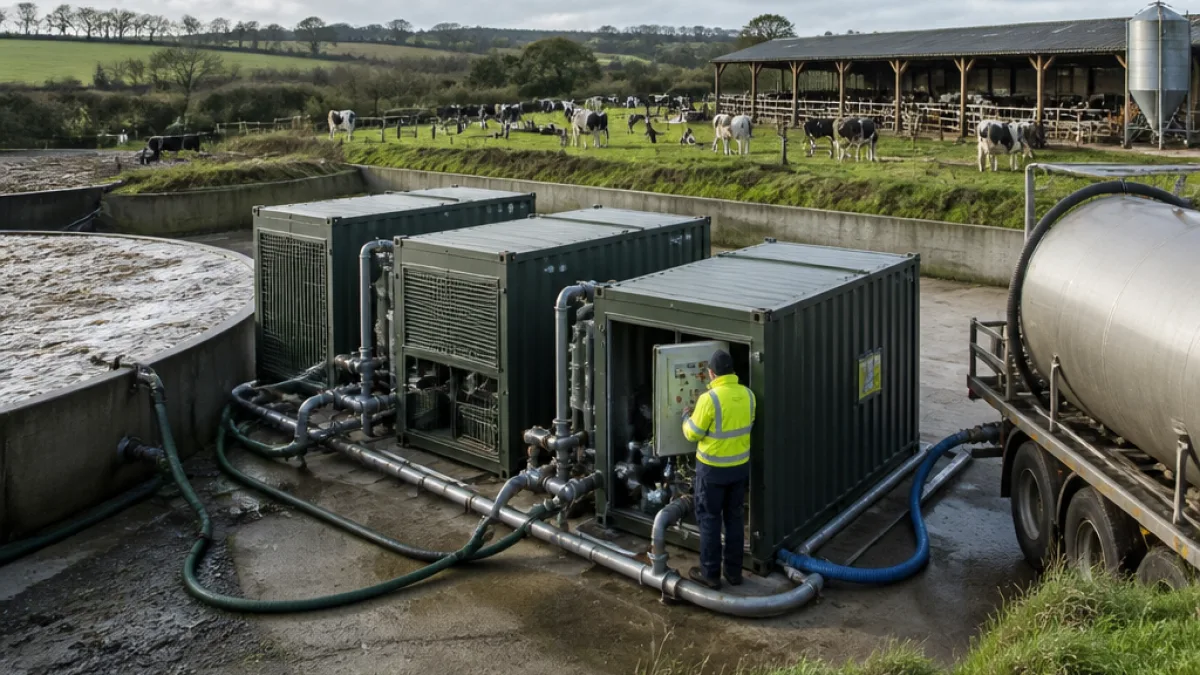
Innovative phosphorus recovery equipment, installed at scale at Harper Adams University’s dairy unit, has consistently removed over 98% of the phosphorus entering the system in trials that began in April 2026. The modular installation, built into three 6m shipping containers, was developed by elentecBio and trialled with funding from Innovate UK in partnership with Defra. The NFU Midlands Regional dairy board visited the site to see the system in operation.
How the system processes slurry
The unit treats separated slurry in a three-stage liquid process after initial solid–liquid separation. According to the project description, the steps are:
- electrocoagulation where an electrical current and iron from electrodes bind with phosphorus and remove suspended solids;
- ultrafiltration to remove finer particles; and
- reverse osmosis to separate water from remaining nutrients.
The system’s modular design allows capacity to be scaled to herd size and slurry processing needs; elentecBio says the cartridge-style electrocoagulation units can process up to 3 cu m/hour. Solids removed by the upstream screw-press separator are those above 0.75mm and contain a high share of phosphorus.
Products from the process and potential uses
The treatment yields three distinct outputs:
| product | description |
|---|---|
| phosphorus-rich fraction | Contains over 98% of the original phosphorus entering the unit |
| phosphorus-stripped liquid | Retains dissolved nitrogen, potassium and salts |
| high-quality processed water | Separated water that could be reused for parlour washdown or as cattle drinking water, subject to Environment Agency approval |
At Harper Adams the modular plant has been operational at scale since April 2026 and is housed adjacent to the slurry store. The project team emphasises that removing solid particles first is important because those particulates contain a high proportion of slurry phosphorus.
Costs and practical challenges
The article outlining the trial notes that the technology ‘does, however, raise challenges and costs’. It describes the installation as being contained in three shipping containers and highlights the staged treatment route from screw-press separation through electrocoagulation, ultrafiltration and reverse osmosis.
The potential outputs — especially a concentrated phosphorus fraction — could influence how farmers manage manure under tightening phosphorus and water-pollution regulation. The process water offers an opportunity to reduce mains water use on farm, but the text is clear that reuse would be subject to Environment Agency approval.
Innovate UK and Defra’s involvement underlines the policy interest in technologies that reduce agricultural phosphorus losses. The NFU Midlands Regional dairy board’s visit indicates farmer and industry engagement with the trials.
Farmers interested in slurry treatment options should discuss site suitability and regulatory compliance with their own advisers and the Environment Agency.