A spectroscopy-based testing method has been developed to identify goat milk diluted with water or mixed with cow milk, according to research from Brazil. The approach produced 94.7% classification accuracy and recorded prediction errors of only a few per cent in tests on three-component mixtures.
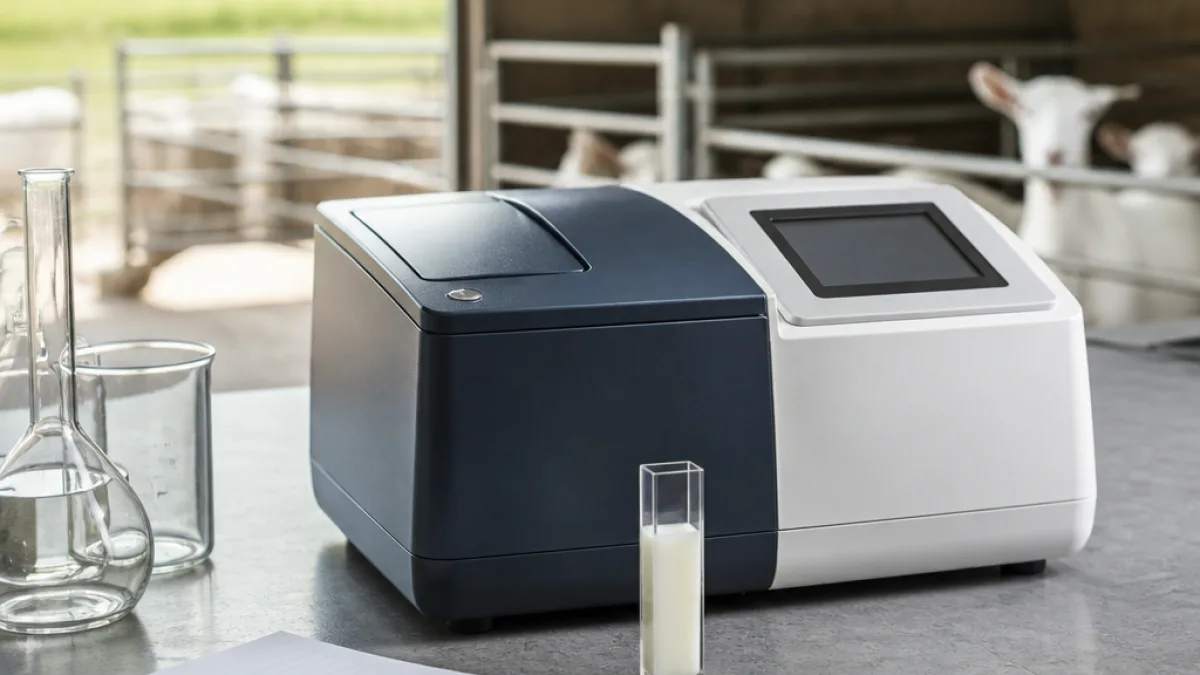
Goat milk is sold at a premium in the dairy market, making product authenticity an important issue for the supply chain. The researchers examined whether a benchtop Fourier-transform near-infrared (FT-NIR) spectrometer, combined with statistical modelling, could provide a practical way to detect adulteration without relying on more expensive tests for foreign DNA or proteins.
Testing mixtures of goat milk, cow milk and water
The method uses near-infrared light to measure signals associated with chemical bonds found in milk, including C–H, N–H and O–H. Those signals were then interpreted using partial least squares (PLS) regression and logistic regression, allowing the researchers to assess both the composition of a sample and its classification.
For the experiment, the team prepared mixtures containing different proportions of goat milk, cow milk and water. A simplex-centroid experimental design was used to sample the full compositional range. Each preparation was made up to 10.0 millilitres in a test tube and kept refrigerated before analysis.
| Research feature | Reported detail |
|---|---|
| Distinct mixtures | 48 |
| FT-NIR spectra collected | 95 |
| Spectrometer | Bruker MPA |
| Wavelength range | 12000 to 4000 cm−1 |
| Scans per sample | 32 |
| Spectral resolution | 8 cm−1 |
| Classification accuracy | 94.7% |
Raw milk was characterised before analysis
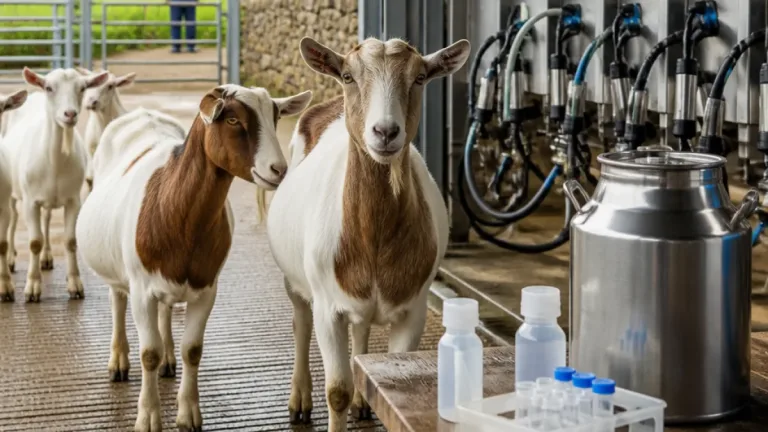
The raw cow milk came from the Milk and Derivatives Laboratory at the Federal University of Lavras and was pooled from different milkings and animals of various breeds. Raw goat milk was supplied frozen by Capril Eldorado farm in Perdões, Minas Gerais.
Before the spectroscopy work began, the researchers recorded physicochemical characteristics for both types of milk. The apparent pH was 6.72 for cow milk and 6.68 for goat milk, while titratable acidity was 0.16% and 0.15% lactic acid, respectively.
Potential role in quality control
The study’s testing process included an outlier check using Hotelling’s T2 test at the 95% confidence level. The remaining results were used to build and assess the statistical models, with 67 spectra assigned to calibration and 29 to independent external validation, as reported in the research summary.
The reported findings indicate that FT-NIR equipment paired with multivariate statistics can distinguish authentic goat milk from samples containing water or cow milk, while also estimating the level of adulteration. That could offer processors and laboratories a faster screening option than methods based on targeted analysis of foreign DNA or proteins. The work was carried out on prepared laboratory mixtures, so its findings relate specifically to the test conditions described by the Brazilian research team.
- The method examined mixtures of goat milk, cow milk and water.
- FT-NIR spectroscopy was combined with PLS and logistic regression.
- The reported classification accuracy was 94.7%.